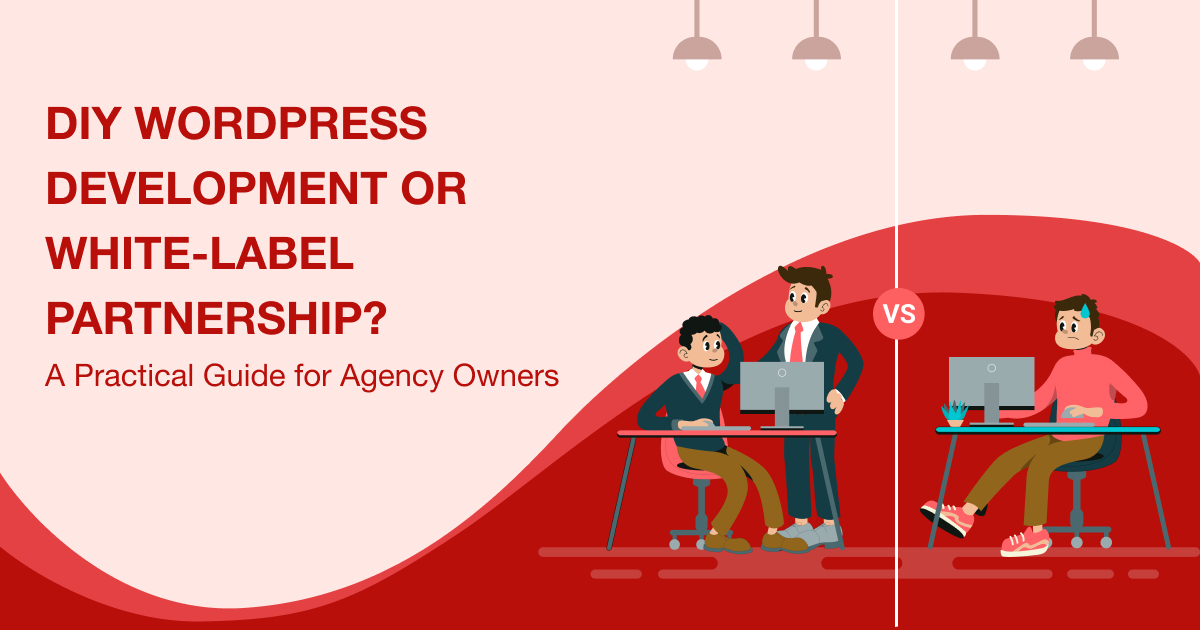
Ready to stop sitting on the fence about whether DIY WordPress development or an outsourced solution is the best way to meet your clients’ needs?
If so, read on.
In this guide, we weigh up the pros and cons of DIY vs. professional WordPress development to help you decide once and for all which approach is the best fit for your particular agency.
Setting the Stage: Why Your Agency’s Development Approach Matters
Look, we get it:
Deciding whether to keep your WordPress development projects in-house or outsource them to a professional isn’t all that straightforward.
Sure, it might be if all you had to do was look at the budget, but let’s face it:
This decision affects much more than just your bottom line.
What happens if you take the DIY route but your workload continually grows to the point that it becomes more than your small agency can realistically handle?
You could find yourself with a team that’s tired, and overworked, the constant stress of meeting one high-pressure deadline after chipping away at the very passion and creativity you hired these people to deliver.
Even if morale doesn’t suffer, the quality of your work might if you need to start cutting corners just to get things done on time.
Then again, pick the wrong developer to help, and there’s every chance that quality standards could slip anyway if it turns out they got your business by promising more than they could actually deliver.
So, yes, there’s a lot to think about, but here’s the thing:
With every day that passes without you deciding between hiring WordPress professionals or doing it yourself, your agency is losing out on an opportunity to grow.
Can your business afford to plateau just because you’ve got a tough decision to make?
Probably not, right?
So, let’s break down the upsides and drawbacks of each option to help you figure things out once and for all.
The DIY Route: When Doing It Yourself Makes Sense
The DIY route can be an attractive one for agencies, offering a number of advantages over outsourced support.
If the following three factors are a top priority for you right now, opting for in-house development may be the most logical and sensible path to take:
Direct Control Over Projects
With DIY development, you’re in charge of every last little detail from the initial project timeline to those last-minute tweaks. This gives you the confidence that no WordPress project goes live unless it meets your high expectations.
More importantly, it can lead to faster turn-around times for those small, low-key projects as you don’t have to wait for an agency partner to make changes for you.
Cost Savings for Low-Budget Projects
Sometimes, saving money just makes sense. Do you really need to pay a developer for that quick and easy update, or is it more cost-effective to just do it yourself?
If any of your projects err on the simple side and you have plenty of capacity in-house, DIY will certainly prove more cost-effective.
Flexibility to Experiment
DIY gives you the freedom to do things your way, even if that means bucking convention.
For example, if you decide it’s time to switch your clients to WordFence rather than another security plugin that you’ve been using for years, or if you’re planning to integrate more automation features to make workflows more efficient – you can just go right ahead and do it without consulting an outside team first.
Naturally, this makes DIY development an excellent choice for both in-house projects where you can enjoy the flexibility to experiment with new things.
Likewise, think about those clients who hire you to create a finished product (say an eCommerce store), but don’t have specific requirements on how you do it or what tools you use.
Wouldn’t it be nice to create that project exactly as you think it should be done, without worrying whether a white-label development partner agrees or not?
The DIY Drawbacks: When You Might Get in Over Your Head
For all of its upsides, handling WordPress development projects isn’t always so ideal.
Even if you’re excited by the possibilities of total creative control, consider the following drawbacks before you make a final decision.
Time and Resource Drain
DIY development takes time, and often lots of it. This may be manageable if you only have one or two clients, but as soon as that workload starts to increase, the pressure is on.
What’s more, every hour that your team spends troubleshooting a faulty plugin or finding that single, erroneous line of code that’s causing problems is an hour they’re not spending on the kind of high-value client work that contributes the most to your ongoing success.
Skill Gaps Lead to Quality Gaps
Doing things in-house is all well and good if your team has the technical skills and experience to tackle complex projects.
After all, there’s much more to WordPress than installing a theme, adding a few plugins, and uploading content.
Does your team have the expertise to create custom database tables or manage complicated security protocols?
What if a client is expecting an influx of traffic for their big holiday sale? Are you well equipped to upgrade their server or implement a sound performance optimization strategy to prepare them for the extra demand?
Sure, you might give it a shot, but unless you’re 100% confident that you know what you’re doing, there’s a serious margin for error.
The type of errors we’re talking about here are those that delay projects and potentially lead to clients receiving poor-quality websites. You know, the kind that can hurt your reputation as a credible, reliable digital agency and send clients into the waiting arms of a better-equipped competitor.
Maintenance Becomes a Burden
WordPress development projects rarely end on the go-live date. Post-launch, someone has to be responsible for tackling updates, troubleshooting errors, and generally keeping that new website in tip-top shape.
Are your clients expecting you to take on that responsibility?
If so, it may not be a problem at first, but what happens once each new client starts adding more and more tasks to your WordPress maintenance checklist?
All that extra work puts extra pressure on your team, possibly resulting in higher stress and lower morale, both of which could be avoided simply by outsourcing website maintenance tasks.
If any of these factors are likely to throw the proverbial spanner in the works when it comes to your long-term growth plans, it’s time to consider if a white-label developer could be the answer.
Bringing in a White-Label WordPress Partner: When It’s Time to Level Up
When we say ‘partner,’ we really do mean it. White-label services aren’t about simply offloading your workload to someone else.
They offer an opportunity to create a valuable partnership focused on growing your agency without the growing pains.
Not convinced? Consider these three pros of hiring WordPress experts:
Access to Experts on Demand
What would it be like to have a team of WordPress experts at your disposal without the added costs and complications of hiring them?
Might it be just the game-changer you need to level up your agency?
It would certainly give you an opportunity to take on larger, more complex -and therefore, more lucrative- projects with the complete confidence that they’re in capable hands.
As a result, your team can concentrate on a manageable workload that makes the most of their talents.
Consistent Quality and Professionalism
Pick a high-quality partner and you get high-quality work that impresses clients and serves as a shining addition to your portfolio.
In other words, you’re not just getting the job done, you’re getting it done to the high standards your agency is staking its reputation on. When you’re known for delivering professional quality services on time, every time, that’s only going to help you when it comes to landing bigger and better projects.
Scalability Without Extra Overhead
A white-label partnership doesn’t have to be a permanent, ongoing relationship. It can be a flexible arrangement that works in your favor when you need it the most.
Just taken on a big project you couldn’t afford to pass up but it’s pushing your team to its limits?
Working on several projects at once and need extra support to get them all over the finish line?
Working with a white-label agency gives the flexibility to expand your team for those all-hands-on-deck projects and reduce your level of support when the workload resumes to normal levels.
The best part, you can do all this without going through a costly hiring process or laying off those extra team members should things slow back down to ‘business as usual’ levels. Need to tackle a larger project or several at once? White-label partnerships let you scale up or down based on workload, without worrying about hiring or layoffs.
Built-In Maintenance and Support
White-label agencies typically offer ongoing WordPress support and maintenance services provided directly to your clients on your behalf.
This means that you no longer need to take those out-of-hours calls when an important client calls you up in a panic because their site isn’t working properly.
The nature of white-labeling means that those clients still perceive that they’re interacting with your agency, but, in reality, that call is going straight to your white-label partner.
As a result, you free up time spent attending to maintenance requests while still ensuring your valued clients get the support they need, when they need it.
The Trade-Offs of White-Label Development
Higher Initial Investment
WordPress development costs can be expensive enough as it is without the high price tag that comes with bringing in another agency.
Of course, this is often a case of paying more upfront to save more money in the long run.
After all, hiring the experts means there’s less risk of costly mistakes that can take time and money to correct.
Still, even though those upfront costs are an investment in your agency’s reputation and long-term success, they could still be a barrier if you’re a smaller operation with a limited budget.
Finding a Reliable Partner Takes Effort
Choosing the right white-label Wor partner can prove to be worth their weight in gold, but finding them in the first place isn’t always simple.
After all, there are scores of WordPress experts for hire out there, but not all of them commit to quality and service standards that align with your own. See our guide to choosing a white-label WordPress partner to see just how much thought and effort goes into the selection process.
Managing Control and Communication
Working with a white-label partner is all about collaboration. As with any collaborative effort, your project management capabilities need to be absolutely on point if everything is going to run smoothly.
If you’ve never worked with an outside agency before, you may encounter new challenges such as communicating goals and expectations with crystal-clear clarity.
Fail to rise to that challenge, and there’s a chance your partner may misunderstand the brief or otherwise deliver a finished product that doesn’t tally with your client’s vision.
When that happens, you’re looking at more delays and incurred costs.
The worst part? Those costs may have been avoided with a more effective approach to project management, complete with tried-and-trusted processes for communicating desired outcomes.
Making the Right Choice: Key Questions for Your Agency
So, you’ve had the opportunity to weigh up the pros and cons of DIY WordPress development and white-label support.
If you’re still on the fence, you’ll find the key to making that all-important decision lies in your answers to three pertinent questions:
- How Complex is the Project? – The DIY approach may be fine for those small, simple projects or internal websites, but what about more technical tasks outside your team’s core skill set? A white-label partner may be a better option to ensure those unique and complex projects are handled with the expertise they deserve.
- How Stretched Is Your Team? – If everyone is at full capacity already, adding WordPress development to their workload may stretch them beyond their limits. As a result, not only do you risk an unhappy team, but once the quality of their work starts to suffer, unhappy clients as well.
- What’s Your Long-Term Goal? – Are your sights set on long-term scalability? Perhaps you’re planning to up your pedigree by offering premium services to high-value clients. Unless you’ve got the internal resources to make that happen, a white-label WordPress developer can be an invaluable asset when it comes to achieving even your agency’s biggest goals.
Looking at a white-label partnership as the right route for your agency? Explore our WordPress development plans and discover how UnlimitedWP can help your agency grow.